interior cleaning
Sand and red dust work their way down into the pile and stay there. Vacuuming takes the top off. This takes the rest out.
Carpet in the Algarve has a harder life than carpet anywhere in northern Europe. Fine red dust blows in and settles, beach sand comes back in on feet and towels, and both of them work their way down to the base of the pile where a vacuum will never reach. Once they are down there they behave like sandpaper, cutting the fibre every time somebody walks across it. That is what makes traffic lanes go dull long before the rest of the carpet does.
Then there is the way properties here are used. A villa that sits empty through the winter with the shutters closed comes back to life smelling of it. Holiday lets take a season of wet feet, sun cream and spilled drinks in twelve weeks. And the rugs people ship out here, wool, kilim, and the good hand made ones, are usually the last thing anyone dares touch, so they go years without a proper clean.
how we do it
What the carpet or rug is actually made of decides everything that follows. Wool, synthetic and natural plant fibre all behave differently when they are wet, and a rug with unstable dye needs a completely different approach. We test in a hidden spot before anything else happens.
Most of what is in a carpet is dry, and dry soil is far easier to remove before water touches it. Skipping this step is the single most common shortcut, and it turns loose dust into mud you then have to chase around.
The hallway, the doorways, the bottom of the stairs and the spot in front of the sofa are not the same job as the middle of the room. They get pre treated and given time to work, and every mark gets identified before it gets touched, because the wrong treatment sets a stain permanently.
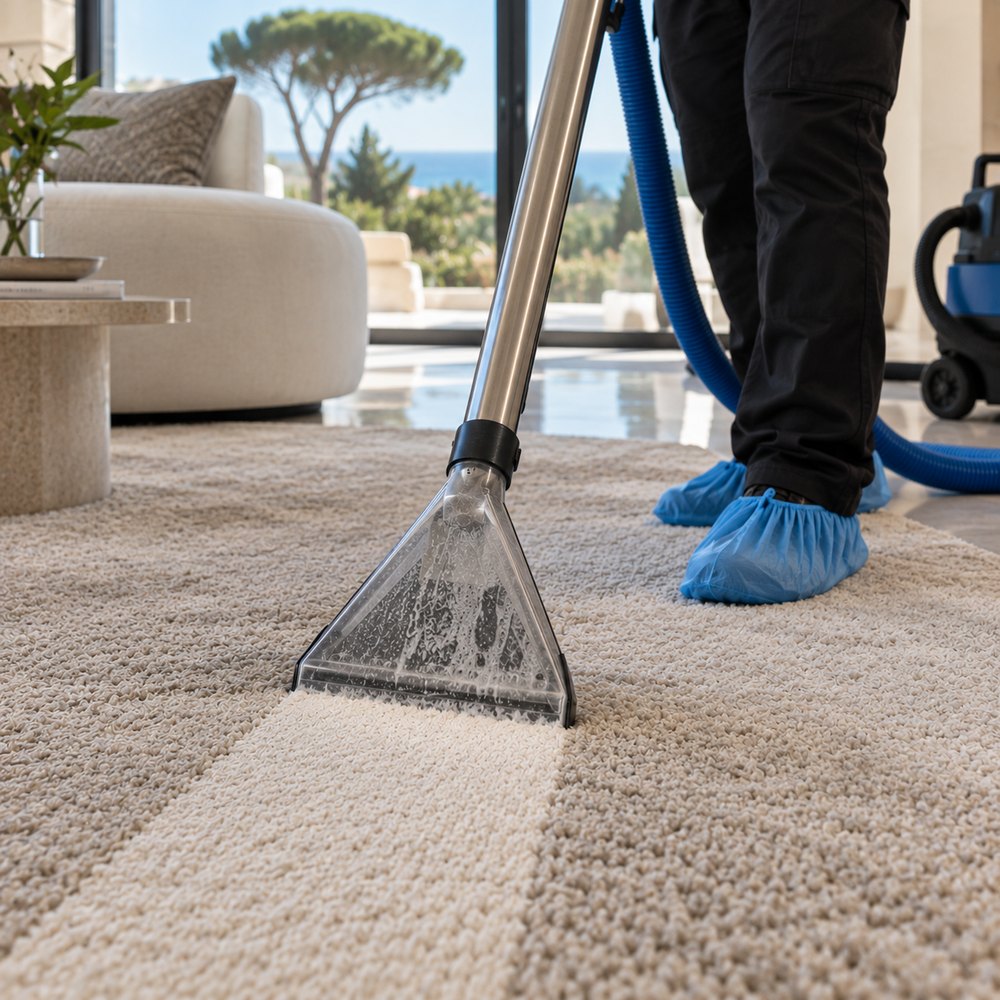
The pile is worked so the solution reaches the base of the fibre rather than sitting on top of it, then the carpet is rinsed and the moisture drawn back out. What comes out is the point of the whole exercise.
The pile is groomed back in one direction so it dries evenly and does not look patchy, and we set up airflow. Getting a carpet dry quickly matters as much as getting it clean, because slow drying is what causes the smell people associate with cleaned carpets.
We show you what came out, what lifted, and anything that did not. If a mark is permanent you will hear it from us rather than discovering it yourself the next day.
what is included
A traffic lane that looks darker than the rest of the carpet is usually two things at once: soil, which comes out, and abrasion, where the fibre itself has been cut and crushed by years of grit underfoot. The soil we can deal with. The abrasion is physical damage to the carpet and no amount of cleaning brings it back. A worn lane will look dramatically better and it will still look like a lane.
The same goes for colour that has already gone. Bleach, some cleaning products, strong sunlight through a patio door and a few spills remove the dye rather than sitting on top of it. Once the dye is gone there is nothing left to clean. We will tell you which of those we are looking at when we survey, not after we have taken your money.
how we keep the standard
Every job is checked against the standard for that surface before the van moves, by someone who did not do the cleaning. If it is not right we put it right before you have to ask.
We look at the property, then give you a price. What we agree at the survey is what you pay, with no extras invented once we are on site.
You can explain what you want and be understood, and we follow up afterwards to check you are happy. Not a sales call.
where we work
We cover Quinta do Lago · Vale do Lobo · Vilamoura · Almancil · Loulé · Quarteira · Faro · Albufeira · Carvoeiro, and the surrounding area. If you are just outside it, ask anyway and we will tell you honestly whether we can look after you properly.
questions
Usually a few hours with the windows open and air moving, longer in a humid spell or a shaded room. We set up airflow before we leave and tell you what to expect for your property. If a carpet is still damp the next day, something has gone wrong with the drying, not the cleaning.
Not if it is treated as wool, which is why we test before we start. Wool and natural fibre rugs need gentler chemistry, less moisture and faster drying than a synthetic carpet. If we test a rug and the dye is unstable, we will tell you it cannot be wet cleaned rather than risk ruining it.
Usually, if the source is in the carpet. Odour from urine sits in the backing and often in the underlay beneath it, so surface cleaning alone masks it for a week and then it comes back in the first warm spell. It needs treating at the source, and if it has gone through into the underlay we will tell you honestly that the underlay is the problem.
Move anything breakable, valuable or personal, and clear the small things off the floor. We will move sofas, chairs and light furniture as we go and put them back. Very heavy items, wardrobes and anything with a lot of electronics behind it, we clean up to rather than shift.
Once a year for a normal household, and more often for a holiday let, a property with dogs or anywhere sand gets walked in daily. Regular cleaning is also what protects the carpet, because leaving grit in the pile is what wears it out.
the rest of the inside